When Should You Call Professionals for Ants in Your Home?
Highlights
- The clearest sign you need professional ant control is finding winged ants indoors during late winter or early spring, which signals an active nest inside your home.
- Carpenter ants require professional treatment far more often than other household ants because locating hidden nests is genuinely difficult.
- DIY sprays rarely solve an infestation since most worker ants never come in contact with the product.
- A known allergy to stinging ants, like fire ants, makes professional removal a safety issue, not just a convenience.
- Persistent ant activity despite cleaning and store-bought treatments usually means the colony is established somewhere inaccessible.
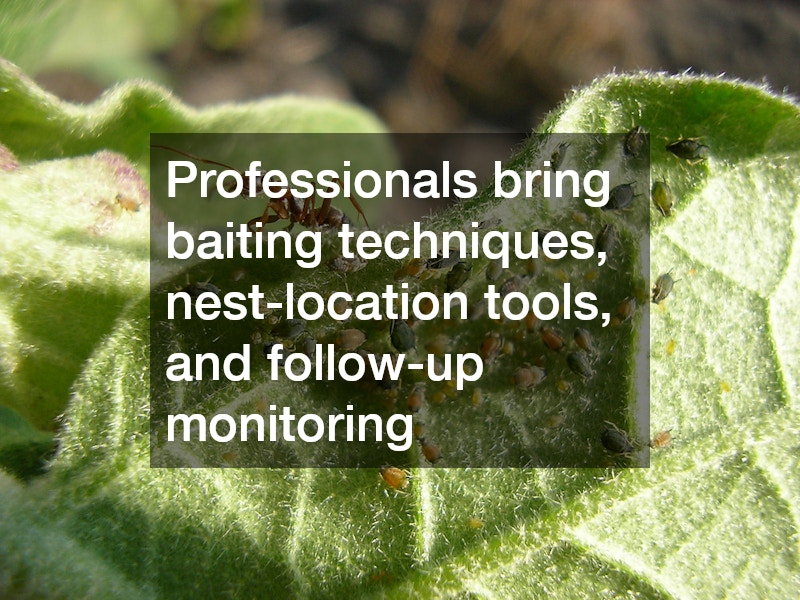
- Professionals bring baiting techniques, nest-location tools, and follow-up monitoring that most homeowners simply can’t replicate.
When Should You Actually Call Professionals for Ants?
You should call professionals for ant control when you find winged ants indoors during late winter or early spring, when store-bought treatments haven’t resolved repeated activity, or when you suspect carpenter ants specifically, since their nests are notoriously difficult to locate without training. A few scattered ants on a kitchen counter during summer rarely justifies a service call, but consistent indoor sightings, physical damage to wood, or an allergy to stinging species all shift the situation from a nuisance into something worth professional attention.
According to University of Minnesota Extension, finding large numbers of winged ants indoors during late winter through spring is a sure sign that a nest exists inside the home, which is exactly the kind of finding that should prompt a call rather than another round of DIY spray.
What Are the Clearest Signs You Need Professional Help?
A few specific indicators reliably separate a minor annoyance from a genuine infestation worth escalating:
- Winged ants appearing indoors — especially in late winter or early spring, which points to an active nest inside
- Coarse sawdust near baseboards or window frames — a classic sign of carpenter ant tunneling
- Consistent sightings of 20 or more workers — suggests an established colony rather than foraging strays
- Ants returning despite cleaning and store-bought bait — often means the nest is hidden somewhere inaccessible
- A rustling sound from inside walls — can indicate an active carpenter ant colony
- Visible structural damage to wood — smooth, sandpaper-like tunnels rather than rough termite damage
Spotting even one or two of these signs is usually enough reason to bring in a professional rather than continuing to treat symptoms without finding the source.
Why Are Carpenter Ants a Special Case?
Carpenter ants deserve their own category of concern because locating their nest, not just treating visible workers, is what actually solves the problem. According to University of Minnesota Extension, carpenter ant control is usually best handled by an experienced pest management professional, since finding and destroying the nest is often extremely difficult due to its hidden nature inside wall voids, subfloors, or attic beams. Homeowners can help by tracking when, where, and how many ants they’ve seen, but the actual nest location typically requires specialized techniques like moisture meters or stethoscopes to detect activity behind walls. Attempting DIY treatment without finding the nest usually just kills visible foragers while leaving the colony, and the underlying moisture problem that attracted it, completely untouched.
Why Doesn’t DIY Spray Usually Work?
Store-bought ant sprays feel like an obvious first move, but they often fail for a structural reason most people don’t realize. Spraying visible worker ants only affects the small percentage of the colony that happens to be foraging at any given moment, while the vast majority of ants, including the queen, remain protected inside the nest entirely unaffected. Worse, spraying near a colony can sometimes trigger it to split into satellite nests as a defensive response, which can actually make an infestation harder to control rather than easier. Professional ant control typically relies instead on baiting strategies, where worker ants carry a slow-acting product back to the nest and share it with the rest of the colony, a method that requires patience and correct placement but actually addresses the root population rather than just what’s visible on the surface.
When Does an Ant Problem Become a Safety Issue?
For most households, ants are a property nuisance rather than a health concern, but certain species change that calculus significantly. According to the Asthma and Allergy Foundation of America, fire ant venom contains proteins that act as allergens, and while most reactions stay localized, some people experience anaphylaxis, a severe systemic reaction that can progress rapidly and requires immediate medical attention. Anyone with a known allergy to stinging insects, or anyone who has experienced symptoms like swelling beyond the sting site, difficulty breathing, or dizziness after a previous sting, should treat an active ant problem near the home as a genuine safety priority rather than something to handle casually. In these situations, professional removal isn’t just about convenience; it directly reduces the risk of repeated exposure for vulnerable household members.
What Approach Do Professionals Actually Use?
Reputable pest control providers generally follow an Integrated Pest Management approach rather than defaulting to broad chemical treatment. According to the EPA’s principles of Integrated Pest Management, this method combines monitoring, accurate identification, and prevention first, escalating to targeted control methods only when those steps aren’t sufficient on their own. For ant control specifically, this often means a technician identifies the exact species first, since carpenter ants, odorous house ants, and pavement ants all require different treatment strategies, then uses targeted baiting or nest-specific treatment rather than a single broad-spectrum spray throughout the home. This kind of species-specific, methodical approach is difficult to replicate with generic store-bought products, which is part of why persistent infestations so often require professional intervention to actually resolve.
How Should You Decide Whether to Call for Help?
Deciding whether to call in professional ant control ultimately comes down to weighing a few honest questions: Has the problem persisted despite reasonable DIY effort? Are there signs pointing to carpenter ants or another structurally damaging species? Does anyone in the household have a known allergy to stinging insects? A single “yes” to any of these is generally enough reason to bring in a professional rather than continuing to manage the problem piecemeal. Waiting too long, especially with carpenter ants, tends to allow more time for structural damage or colony expansion, which only makes the eventual professional treatment more involved than it would have been earlier.
What’s the Bottom Line on Calling for Professional Ant Control?
Most ant problems don’t require professional intervention right away, but a specific set of signs, winged ants indoors, persistent activity despite treatment, suspected carpenter ant damage, or an allergy concern, all point toward calling in a professional rather than continuing DIY efforts. Locating the actual nest, correctly identifying the species, and using targeted rather than broad-spectrum treatment are exactly the areas where professional expertise makes the biggest difference. Recognizing these signals early, rather than waiting until damage or discomfort becomes severe, is what turns a manageable ant problem into a quickly resolved one instead of a drawn-out, costly infestation.